
Importance of Mock Interviews for Teacher Exams (PGT, TGT, KVS, NVS)

Preparing for teaching exams like PGT, TGT, KVS, and NVS is often seen as a journey of mastering written content subjects, pedagogy, and current affairs. But what many aspirants overlook is that the written test is only the first gate. The real test of your personality, communication, and suitability as a teacher happens in the interview stage.
This is where mock interviews make a huge difference. They are not just practice sessions but simulated real experiences that prepare you mentally and emotionally for facing the actual panel.
In this blog, we will dive deep into:
- Why interviews matter in teaching exams
- Benefits of mock interviews
- What interview panels expect
- Common mistakes aspirants make
- Sample interview questions
- How to prepare with mock interviews effectively
- FAQs about teacher interviews
Join Ardas Classes Now
India's Best UGC-NET Coaching Centre
Why Are Interviews Important in Teacher Exams?
Most aspirants spend months preparing for the written test, but often the interview decides the final selection. Panels want more than just book knowledge; they want a teacher who can inspire, explain, and lead a classroom.
Some reasons why interviews carry weight:
- Evaluate Subject Command – A teacher should explain tough concepts simply.
- Assess Pedagogical Skills – Your ability to apply methods, not just recall theories.
- Judge Personality Traits – Patience, empathy, clarity, confidence.
- Practical Understanding – Classroom management, handling diverse students, integrating NEP guidelines.
For a detailed look at interview-focused preparation, check our KVS Interview Tips
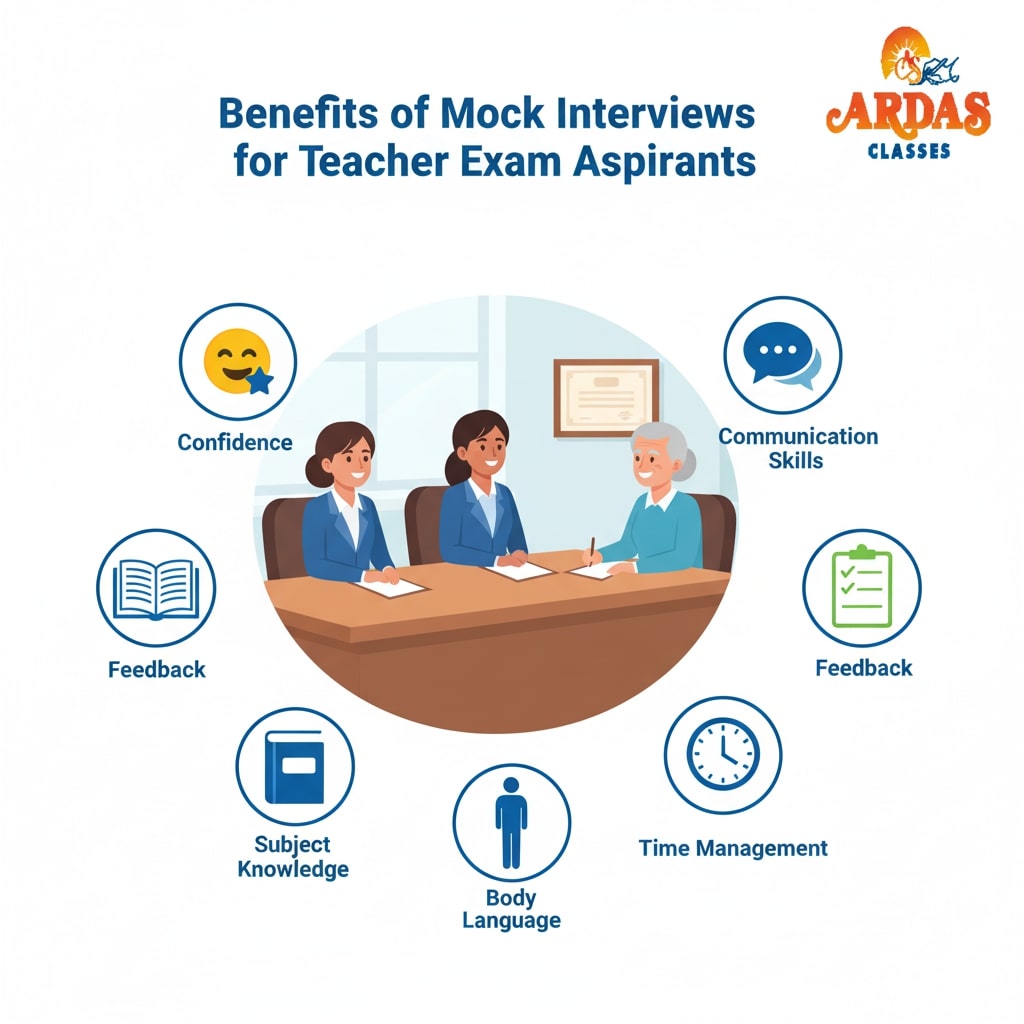
Benefits of Mock Interviews for Teacher Exam Aspirants
Mock interviews act like a mirror. They show you where you stand before you actually face the panel. Here is why they are a must for every aspirant:
1. Builds Confidence
The first time facing a panel can feel overwhelming. A mock session reduces fear by making the environment familiar.
2. Improves Communication Skills
You may know the right answer, but how you say it matters. Mock interviews sharpen your articulation, clarity, and body language.
3. Identifies Hidden Weaknesses
From excessive fillers (“umm, actually, basically…”) to lack of eye contact, trainers can point out flaws you may not notice yourself.
4. Enhances Subject Presentation
Especially in PGT and TGT, candidates are often asked to explain how they would teach a topic. Practicing this beforehand helps.
5. Boosts Time Management
Interview time is limited. Mock sessions teach you to deliver precise, powerful answers instead of long, confusing explanations.
6. Reduces Exam Anxiety
Repeated exposure reduces nervousness, helping you remain calm under real conditions.
Related read: How to Impress in KVS PRT Interview
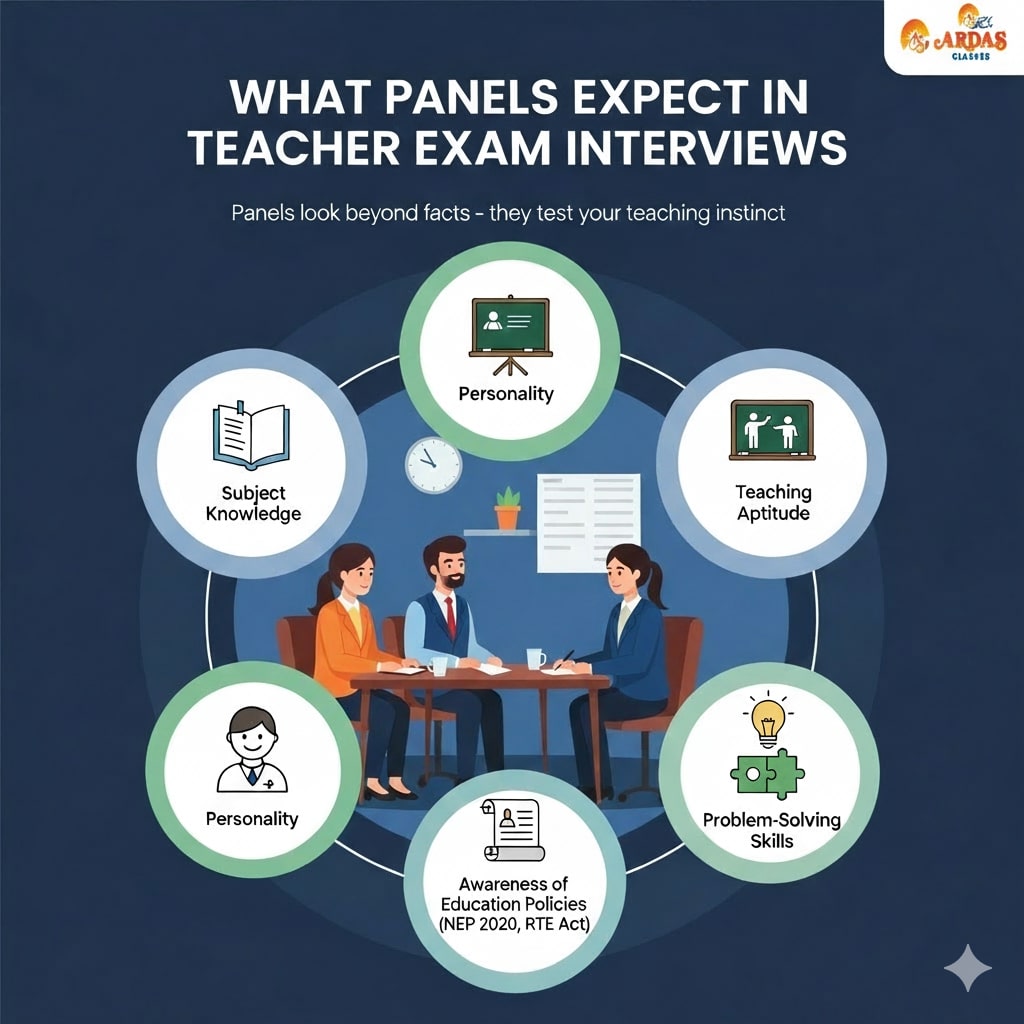
What Panels Expect in Teacher Exam Interviews
Interviewers assess you on five major areas:
- Subject Knowledge – Do you have strong command over your subject?
- Teaching Aptitude – Can you explain concepts in simple terms?
- Personality – Are you approachable, confident, and disciplined?
- Awareness of Education Policies – NEP 2020, RTE Act, Child Rights.
- Problem-Solving Skills – How would you handle classroom discipline or slow learners?
Panels don’t just ask factual questions. They create situational scenarios to test your teaching instinct.
Common Mistakes Aspirants Make in Teacher Interviews
Even the most well-prepared candidates sometimes lose valuable marks in interviews due to avoidable mistakes. Understanding these mistakes in advance can help you stay alert and perform with confidence.
1. Memorized Answers Instead of Genuine Responses
Many aspirants prepare scripted answers for questions like “Why do you want to become a teacher?”. While preparation is good, panels can instantly detect when an answer sounds mechanical or rehearsed. They are not looking for memorized lines but for authentic, thoughtful responses that reflect your true personality, teaching philosophy, and passion for education.
Tip: Prepare key points, but deliver answers naturally in your own words.
2. Poor Body Language
Communication is not only verbal; non-verbal cues often say more than your words. Slouching on the chair, avoiding eye contact, crossing arms defensively, or fidgeting with your hands creates an impression of nervousness or lack of confidence.
Tip: Sit upright, make comfortable eye contact with panelists, smile politely, and use controlled hand gestures when needed.
3. Overconfidence or Talking Too Much
Some candidates try to impress the panel by speaking excessively or interrupting the interviewers. This can backfire, as overconfidence is often mistaken for arrogance. Panels prefer candidates who are confident yet humble, who listen carefully before answering, and who can be concise and respectful in communication.
Tip: Keep your answers clear and to the point. Show confidence without overshadowing humility.
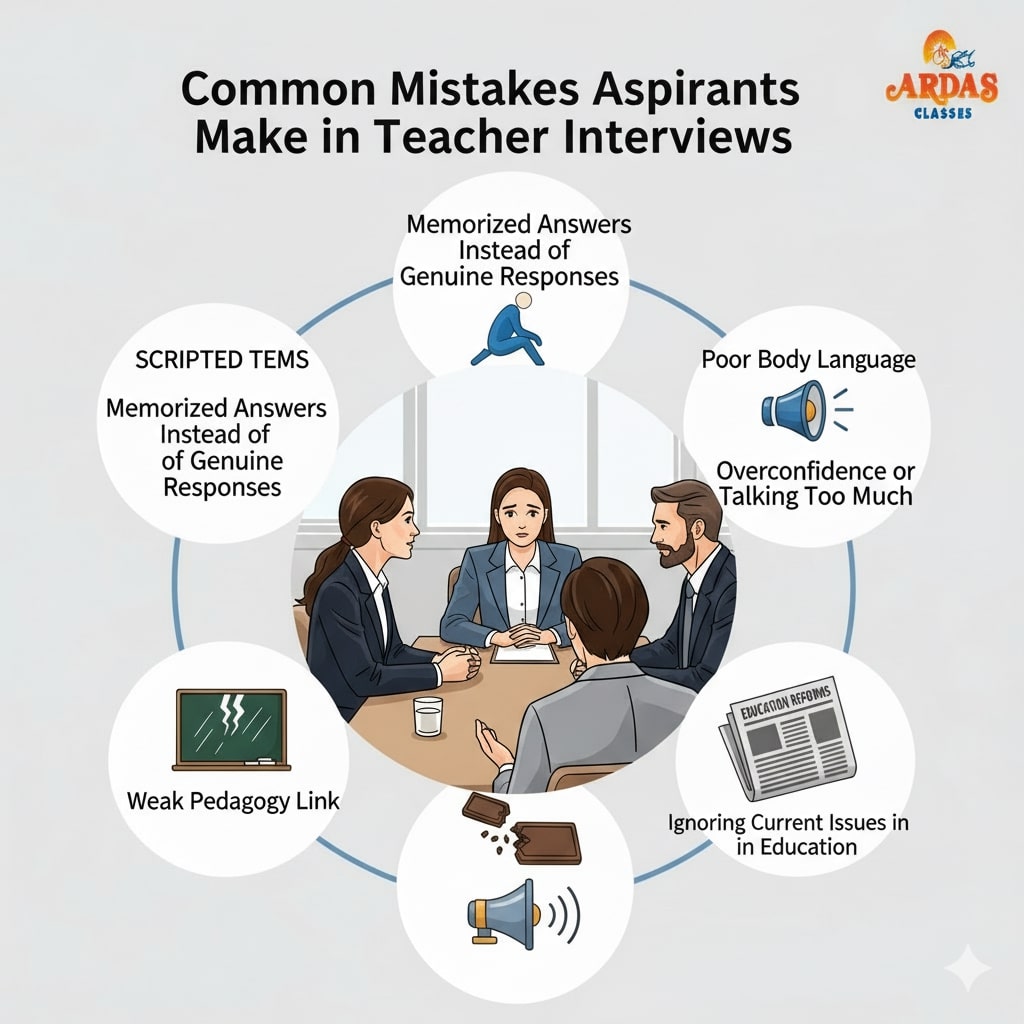
4. Weak Pedagogy Link
Teacher interviews don’t just test your subject knowledge — they want to know if you can teach that knowledge effectively. Many aspirants give purely theoretical answers without linking them to classroom application. For example, explaining “plate tectonics” in Geography is different from teaching plate tectonics to students in a classroom.
Tip: Always connect answers to pedagogy. Use simple language, real-life examples, and teaching methods (like diagrams, activities, or storytelling).
5. Ignoring Current Issues in Education
Panels often include questions about educational policies, new teaching trends, and classroom challenges. If you are unaware of the National Education Policy (NEP) 2020, child psychology developments, or digital teaching methods, you may appear outdated. Teachers are expected to be aware of current reforms, inclusivity, mental health, and technology in education.
Tip: Stay updated with current affairs related to education. Read about NEP 2020, use examples of online teaching, and highlight your awareness of inclusivity and student well-being.
See our blog on Top 10 KVS PRT Interview Questions for real examples.
Join Ardas Classes Now
India's Best UGC-NET Coaching Centre
Sample Questions in PGT, TGT, KVS & NVS Interviews
Here are sample questions often asked:
General Personality Questions
- Why do you want to be a teacher?
- What qualities make you a good teacher?
- How will you contribute to the institution beyond teaching?
Subject-Oriented Questions
- Explain the concept of “Adiabatic Lapse Rate” in Geography. How will you teach this to high school students?
- What are Bloom’s Taxonomy levels, and how will you apply them in your classroom?
- How do you integrate maps and charts while teaching Geography?
Pedagogy & Classroom Management Questions
- How do you handle a class where students are constantly distracted?
- What teaching methodology do you prefer — lecture, activity-based, or blended? Why?
- How would you teach a difficult topic like “Climatology” to students with no prior exposure?
Current Affairs & Policy Questions
- What’s your opinion on NEP 2020?
- How should teachers adapt to online learning platforms?
- How would you promote inclusivity in your classroom?
How to Make the Most of Mock Interviews
Here’s how aspirants can maximize value from mock sessions:
- Take Them Seriously – Treat it as the final interview. Dress formally, maintain etiquette.
- Record and Review – Watch your own performance. Body language flaws become visible.
- Seek Professional Feedback – Coaches and mentors point out areas you miss.
- Practice Subject Explanation – Especially for PGT & TGT, where subject demo questions are common.
- Simulate Stress Conditions – Practice with strict timing, unfamiliar questions, and cross-questions.
For more preparation strategies, check DSSSB TGT/PGT Preparation Tips
Real Success Stories: Why Mock Interviews Work
At Ardas Classes, many students have shared that mock interviews were the turning point in their selection.
- A UGC-NET qualified candidate cracked her KVS PGT interview after 3 rounds of mock practice, improving her body language and content delivery.
- A TGT aspirant learned to answer child psychology questions effectively only after repeated feedback in mocks.
- A DSSSB candidate realized he was using too much technical jargon and simplified his answers for real success.
These stories prove that mock interviews do not just polish you, they transform you into a confident teacher.
FAQs About Teacher Exam Interviews
Q1. Are mock interviews necessary if I already have good subject knowledge?
Yes. Panels look for how you present, not just what you know.
Q2. How many mock interviews should I attend?
At least 3–5 sessions with feedback before your actual interview.
Q3. What is the difference between a mock interview and a real one?
Except for the final selection, almost nothing. A good mock simulates real conditions.
Q4. Will KVS and NVS interviews ask the same type of questions?
Largely similar, but NVS may focus more on residential school management.
Largely similar, but NVS may focus more on residential school management.
Practice explaining topics in simple language, using examples, and linking theory to real life.
Conclusion
The interview stage is the final gateway to becoming a government teacher in PGT, TGT, KVS, or NVS exams. Mock interviews give you the confidence, clarity, and skills to excel when it matters the most.
At Ardas Classes, we go beyond written preparation. Our mock interview sessions are designed to prepare you for real-life panel challenges, ensuring that you enter the room ready to impress.
If you’re serious about clearing your interview, don’t leave it to chance. Start with mock interviews today and turn your hard work into selection.


