
Career Growth After Clearing KVS/NVS Teacher Exams

Securing a teaching position in India’s prestigious Kendriya Vidyalaya Sangathan (KVS) or Navodaya Vidyalaya Samiti (NVS) is more than just achieving a government job. It is the start of a dynamic and fulfilling career in education. These institutions are among the most respected school systems in the country, known for their high academic standards, modern teaching environment, and nationwide presence.
Every year, thousands of passionate educators prepare tirelessly to clear the KVS and NVS recruitment exams, drawn by the promise of stability, respect, and the chance to shape young minds across India. But what many candidates do not realize is that clearing the exam is only the first step in a much larger journey. Once appointed, teachers enter a well-defined professional ladder that opens doors to promotions, leadership roles, and administrative positions at regional and national levels.
From beginning as a Primary Teacher (PRT) or Trained Graduate Teacher (TGT) to advancing to roles like Vice Principal, Principal, Education Officer, or even Deputy Commissioner, the growth opportunities within KVS and NVS are both structured and substantial. Each step up not only brings increased responsibility and recognition but also a significant boost in salary, perks, and professional status.
Beyond promotions, teachers enjoy a stable income under the 7th Pay Commission, continuous skill development programs, and the satisfaction of working within India’s most efficient and well-managed educational frameworks. With opportunities for training, transfers, and administrative leadership, the KVS/NVS system ensures that every dedicated teacher has a clear and rewarding career path ahead.
If you have ever wondered what lies beyond clearing the KVS or NVS exam, this article will walk you through the complete promotion hierarchy, pay scale, and future opportunities that make this career one of the most respected and growth-oriented choices in Indian education.
Join Ardas Classes Now
India's Best KVS/NVS Exam Coaching Classes
Starting Roles After Selection
Clearing the KVS or NVS teacher recruitment exam opens the gateway to a prestigious and secure government teaching career. Once selected, candidates are appointed to specific roles based on their educational qualification, teaching experience, and the category they applied for. Each of these positions carries distinct responsibilities, pay scales, and growth potential within the system.
Primary Teacher (PRT)
Classes Taught: I to V
Qualification Required: Senior Secondary (or equivalent) with Diploma/B.Ed. in Elementary Education

PRTs are responsible for laying the academic foundation of students during their early school years. They teach subjects like English, Mathematics, Environmental Studies, and Regional Languages while focusing on developing core skills such as reading, comprehension, and basic reasoning.
Apart from classroom teaching, PRTs organize co-curricular activities, student assemblies, and interactive learning sessions to make early education joyful and effective. They also collaborate closely with parents to monitor each child’s growth and learning habits.
PRTs gain valuable classroom experience, which later helps them qualify for promotions to TGT and eventually PGT positions through departmental exams and seniority.
Trained Graduate Teacher (TGT)
Classes Taught: VI to X
Qualification Required: Bachelor’s Degree in the concerned subject with B.Ed.

TGTs handle subject-specific teaching, guiding students through intermediate concepts in science, mathematics, social science, and languages. Their role is pivotal in helping students transition from foundational to advanced learning.
TGTs are often assigned additional responsibilities like Class Teachers, House In-charges, or Academic Coordinators, which strengthen their leadership and administrative skills that are crucial for future promotions to PGT or Vice Principal levels.
They also contribute to exam evaluation, project guidance, and student mentoring for Olympiads, exhibitions, and competitions.
Post Graduate Teacher (PGT)
Classes Taught: XI and XII
Qualification Required: Postgraduate Degree in the subject + B.Ed.

PGTs represent the highest teaching cadre in schools. They teach specialized subjects at the senior secondary level, preparing students for board examinations and competitive entrance tests.
PGTs play a dual role such as educators and as mentors guiding students in career planning, subject selection, and exam preparation. They often lead departmental meetings, contribute to school policy decisions, and assist the principal in maintaining academic standards.
With sufficient experience, PGTs are eligible for promotion to Vice Principal and later to Principal and administrative positions at regional or national levels.
The Promotion Ladder in KVS/NVS
Career growth in KVS and NVS follows a well-defined hierarchy, allowing teachers to climb up based on seniority, performance, and departmental exams.
For PRTs:
PRT → TGT → PGT → Vice Principal → Principal → Education Officer
For TGTs:
TGT → PGT → Vice Principal → Principal → Deputy Commissioner
For PGTs:
PGT → Vice Principal → Principal → Assistant Commissioner → Deputy Commissioner → Joint Commissioner → Commissioner
With every step, both responsibility and salary increase significantly. Promotions typically occur every 5–10 years depending on vacancies and performance.
Pay Scale & Salary Growth
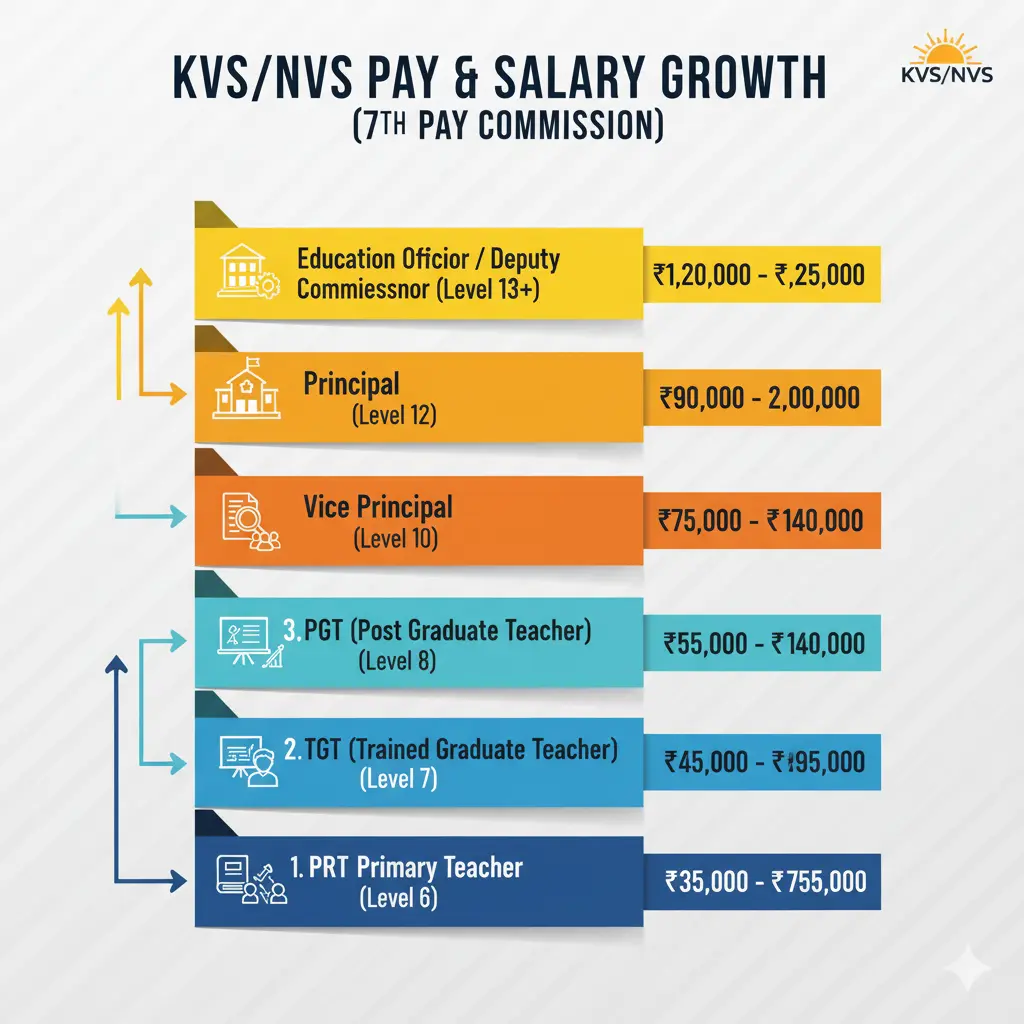
Here is a simplified view of KVS/NVS pay scales under the 7th Pay Commission:
| Position | Pay Level | Approx. Monthly Salary (₹) |
|---|---|---|
| PRT | Level 6 | 35,000 – 75,000 |
| TGT | Level 7 | 45,000 – 90,000 |
| PGT | Level 8 | 55,000 – 1,05,000 |
| Vice Principal | Level 10 | 75,000 – 1,40,000 |
| Principal | Level 12 | 90,000 – 2,00,000 |
| Education Officer / Deputy Commissioner | Level 13+ | 1,20,000 – 2,25,000 |
Additional Allowances and Perks
All KVS/NVS teachers are central government employees and enjoy several benefits and allowances in addition to their basic pay:
- Dearness Allowance (DA): Revised every 6 months based on inflation.
- House Rent Allowance (HRA): 8% to 24% of basic pay (depending on city).
- Transport Allowance (TA): Monthly travel reimbursement.
- Medical Benefits: Coverage under Central Government Health Scheme (CGHS) or equivalent.
- Leave Travel Concession (LTC): For travel to hometown or all-India tours.
- Pension & Retirement Benefits: Under the National Pension System (NPS).
- Children Education Allowance (CEA): Up to ₹2,250 per child per month.
These benefits, combined with job security and a structured promotion policy, make KVS/NVS teaching positions some of the most respected and rewarding government jobs in India.
Transfer and Exposure Benefits
One of the unique advantages of working with Kendriya Vidyalaya Sangathan (KVS) and Navodaya Vidyalaya Samiti (NVS) is the nationwide transfer policy, which provides teachers with valuable exposure to India’s vast diversity. Teachers are posted in different parts of the country from major metropolitan cities to small towns and rural areas allowing them to experience various cultures, languages, and educational environments.
Transfers typically take place every few years, depending on seniority, preferences, vacancies, and administrative requirements. Teachers can submit their preferred posting locations during the annual transfer process, which is handled transparently through an online system in both KVS and NVS.
In addition, those who serve in “hard stations” such as remote, hilly, or North-Eastern regions which receive special allowances, priority in future transfers, and additional promotion benefits. This not only compensates for the challenging work environment but also motivates teachers to contribute to areas where quality education is most needed.
Administrative Opportunities Beyond Teaching
Once a teacher gains experience, opportunities open beyond classroom teaching. You can move into school leadership and educational administration roles such as:
- Vice Principal / Principal: Lead a school, manage staff, and ensure academic quality.
- Education Officer / Assistant Commissioner: Oversee multiple schools in a region.
- Deputy Commissioner / Joint Commissioner: Manage entire regional zones.
- Director or Commissioner: Top-level national administrative positions in KVS/NVS.
These roles not only enhance your status but also come with significant financial rewards and influence in shaping educational policy.
Read More - Administrative Opportunities Beyond Teaching in KVS or NVS
Join Ardas Classes Now
India's Best KVS/NVS Coaching Classes
Conclusion
Clearing the KVS/NVS Teacher Exam is not the end. It is just the beginning of a prestigious and progressive career. With steady promotions, growing pay scales, and opportunities to lead at the national level, KVS and NVS teachers enjoy one of the most rewarding career paths in India’s education system.
If you are preparing for KVS or NVS exams, remember you are not just studying for a job, but for a lifelong career in shaping India’s education future.
FAQs on “Career Growth After Clearing KVS/NVS Exams
1. What is the promotion hierarchy in KVS and NVS?
In KVS/NVS, teachers can grow from PRT → TGT → PGT → Vice Principal → Principal → Education Officer → Deputy Commissioner. Promotions depend on seniority, performance, and departmental exams.
2. What is the salary of a KVS/NVS teacher after the 7th Pay Commission?
- PRT: ₹35,000 – ₹75,000
- TGT: ₹45,000 – ₹90,000
- PGT: ₹55,000 – ₹1,05,000
- Vice Principal: ₹75,000 – ₹1,40,000
- Principal: ₹90,000 – ₹2,00,000
These include allowances like DA, HRA, TA, and pension benefits.
3. How long does it take to get promoted in KVS/NVS?
Typically, promotions occur every 5–10 years, depending on seniority, performance appraisals, and available vacancies. Teachers who perform exceptionally well may be promoted sooner.
4. Can KVS/NVS teachers move into administrative roles?
Yes. Experienced teachers can be promoted to Vice Principal, Principal, Assistant Commissioner, or Deputy Commissioner positions, and even work with the Ministry of Education or NCERT on deputation.
5. Are there training or development programs for KVS/NVS teachers?
Absolutely. Teachers undergo regular workshops and professional training through KVS/NVS, NCERT, and NIE. These programs help them upgrade skills, adopt new teaching methods, and qualify for higher positions.
6. Is a KVS or NVS teaching job good for long-term career growth?
Yes, KVS/NVS offer one of the best career growth systems in government education job security, attractive pay, promotions, and opportunities to move into leadership and policy-making roles.


