
Career Growth After Clearing DSSSB Teacher Exams

Teaching under the Delhi Subordinate Services Selection Board (DSSSB) is one of the most prestigious and stable government career options for educators in India. Each year, thousands of aspirants compete for DSSSB’s teaching posts in Delhi government and MCD schools, attracted by the promise of job security, excellent pay, urban postings, and long-term career growth.
But what many candidates do not realize is that clearing the DSSSB exam is not the end of the journey. It is the beginning of a well-structured career path that leads from classroom teaching to administrative leadership roles in the Delhi education system.
In this article, we will break down the career growth opportunities, promotion hierarchy, pay scales, and professional advantages you can expect after clearing the DSSSB Teacher Exam.
Join Ardas Classes Now
India's Best DSSSB Coaching Centre
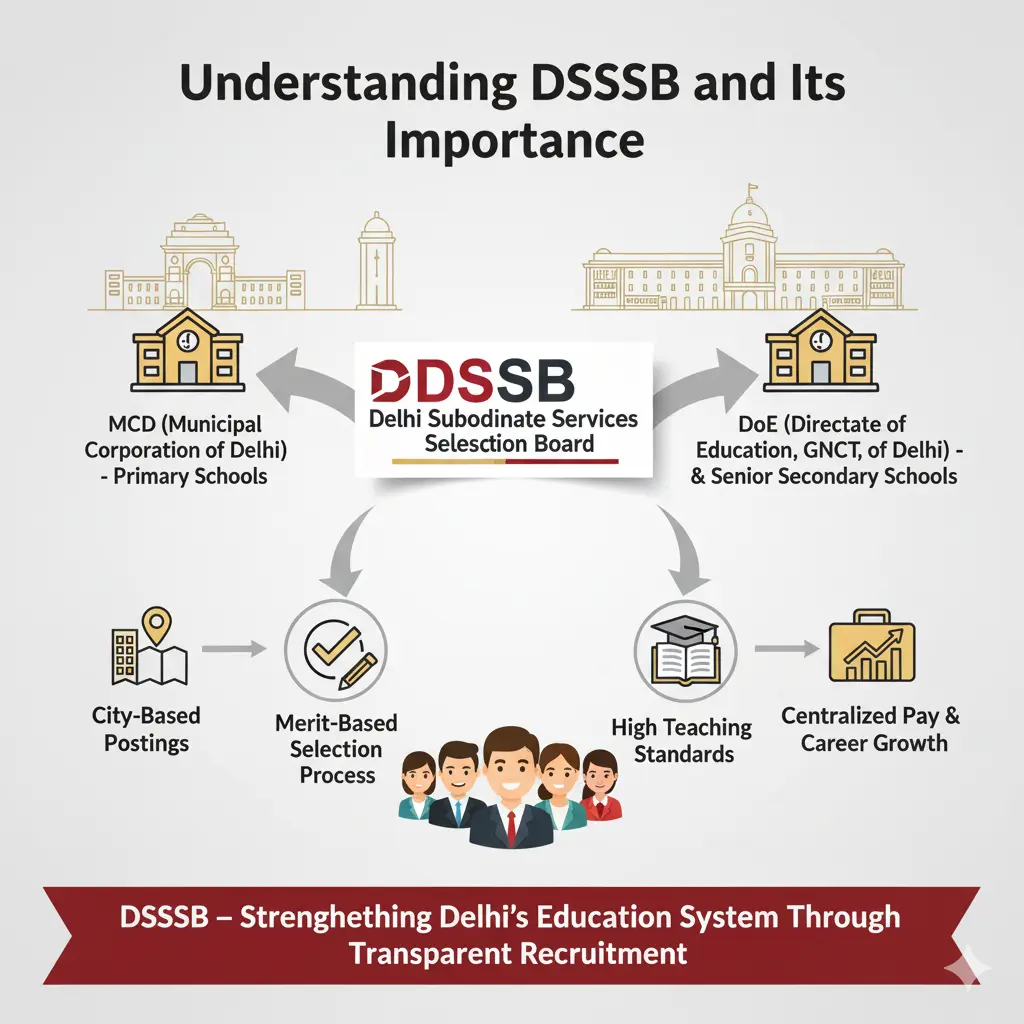
Understanding DSSSB and Its Importance
The Delhi Subordinate Services Selection Board (DSSSB) recruits teachers and staff for Delhi Government Schools (under the Directorate of Education) and Municipal Corporation of Delhi (MCD) Schools.
These institutions are known for maintaining high teaching standards, modern infrastructure, and a systematic administrative structure. DSSSB ensures that qualified, skilled educators are placed in these schools through a transparent, merit-based selection process.
Teachers selected through DSSSB serve in schools that fall under:
- DoE (Directorate of Education, GNCT of Delhi) - for secondary and senior secondary levels.
- MCD (Municipal Corporation of Delhi) - for primary levels.
Once appointed, teachers enjoy centralized pay structures, city-based postings, and excellent career progression opportunities.
Initial Appointments After Clearing DSSSB
After clearing the DSSSB exam, candidates are appointed to posts based on their educational qualifications and category. The three main levels of teaching positions are:
Primary Teacher (PRT)
- Teaches: Classes I–V
- Qualification: 12th + D.El.Ed./B.El.Ed. + CTET (Paper I)
- Posting: MCD schools or DoE primary sections
- Role: Foundation builder to develops literacy, numeracy, and basic skills in young children.
Trained Graduate Teacher (TGT)
- Teaches: Classes VI–X
- Qualification: Bachelor’s Degree in the subject + B.Ed. + CTET (Paper II)
- Posting: Directorate of Education schools
- Role: Teaches specialized subjects (Math, Science, English, Social Studies, Hindi, etc.), mentors middle-school students, and prepares them for board transitions.
Post Graduate Teacher (PGT)
- Teaches: Classes XI–XII
- Qualification: Master’s Degree in the subject + B.Ed.
- Posting: Senior Secondary schools under DoE
- Role: Guides senior students, manages subject departments, and helps with academic planning and board exam preparation.
Initial Pay Scales (7th Pay Commission)
| Post | Pay Level | Grade Pay (Old) | Approx. Monthly Salary (₹) | Basic Pay (₹) |
|---|---|---|---|---|
| PRT | Level 6 | ₹4,200 | ₹40,000 – ₹75,000 | ₹35,400 |
| TGT | Level 7 | ₹4,600 | ₹50,000 – ₹90,000 | ₹44,900 |
| PGT | Level 8 | ₹4,800 | ₹60,000 – ₹1,10,000 | ₹47,600 |
All teachers also receive Dearness Allowance (DA), House Rent Allowance (HRA), Transport Allowance (TA), Medical, and Pension (NPS) benefits, making DSSSB jobs both lucrative and secure.
Promotion Hierarchy in DSSSB Teaching Jobs
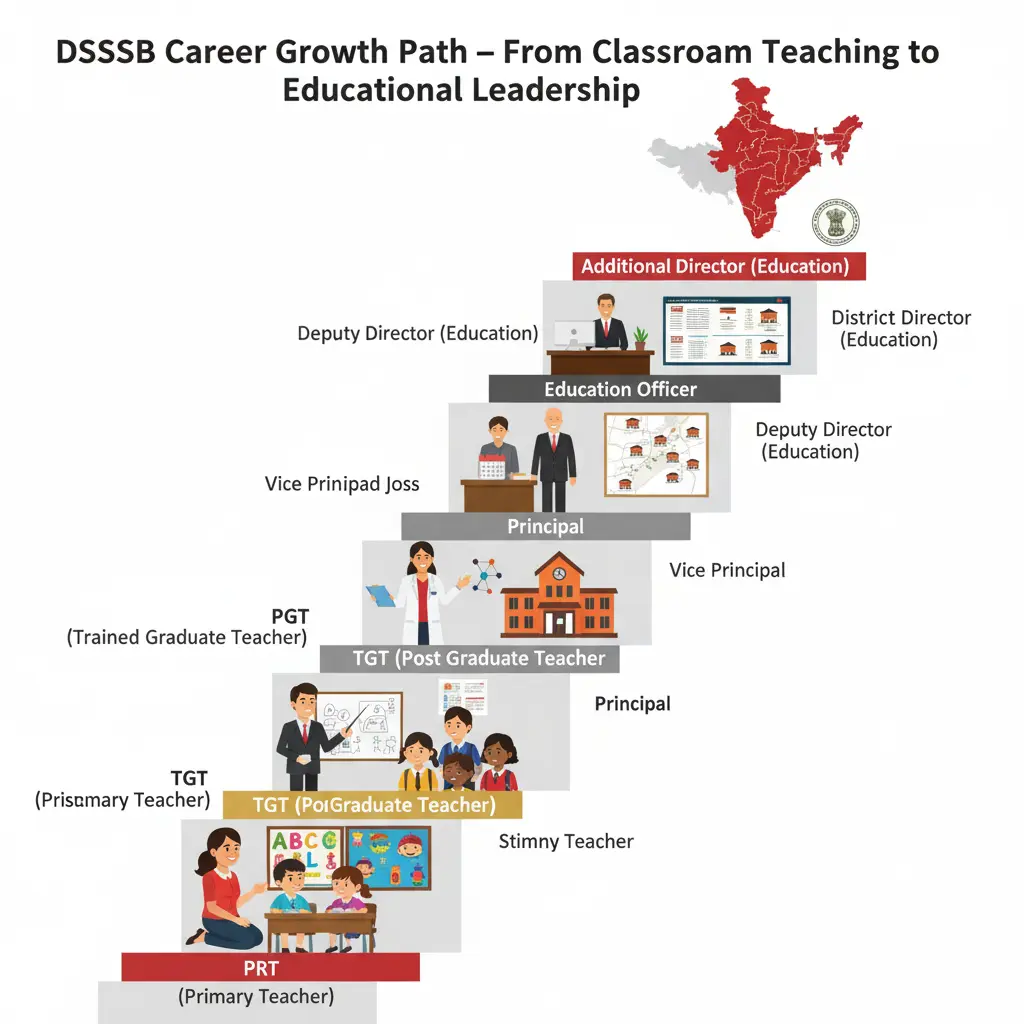
The DSSSB education structure offers one of the most systematic promotion ladders in the teaching sector. Promotions are granted based on seniority, service records, and Departmental Promotion Committee (DPC) recommendations.
Here is how the typical growth ladder looks:
Career Progression Path
PRT → TGT → PGT → Vice Principal → Principal → Education Officer → Deputy Director (Education) → Additional Director (Education)
- From PRT to TGT: After a few years of service and acquiring the required qualifications, a PRT can apply for promotion to TGT through the internal DPC process.
- From TGT to PGT: With additional qualifications (postgraduate degree) and experience, teachers can advance to the PGT level.
- From PGT to Vice Principal/Principal: Promotion to leadership roles depends on experience, achievements, and successful completion of DPC evaluations.
- Beyond Principal: Senior educators can be promoted to Education Officer or Deputy Director of Education, managing zones, departments, or entire school clusters in Delhi.
Each step brings not only a higher salary and responsibility but also an increase in administrative influence and decision-making power.
Pay Scale & Allowances
Under the 7th Central Pay Commission (CPC), DSSSB teachers enjoy structured pay scales with automatic increments and periodic revisions.
| Designation | Pay Level (7th CPC) | Approx. Salary Range (₹/Month) | Promotion Stage |
|---|---|---|---|
| PRT | Level 6 | ₹40,000 – ₹75,000 | Entry Level |
| TGT | Level 7 | ₹50,000 – ₹90,000 | After 5–7 years |
| PGT | Level 8 | ₹60,000 – ₹1,10,000 | Mid-Level |
| Vice Principal | Level 10 | ₹75,000 – ₹1,40,000 | Senior Role |
| Principal | Level 12 | ₹90,000 – ₹2,00,000 | Leadership Role |
| Education Officer / Deputy Director | Level 13+ | ₹1,20,000 – ₹2,25,000 | Top Administration |
Additional Perks & Benefits
- DA (Dearness Allowance): Adjusted biannually for inflation.
- HRA (House Rent Allowance): 8%–24% based on Delhi zone.
- Transport Allowance: ₹3,600–₹7,200 per month.
- Medical Facilities: Provided under CGHS or empanelled hospitals.
- Leave Travel Concession (LTC): For family travel within India.
- Pension (NPS): Contribution-based retirement benefits.
These make DSSSB jobs financially stable and socially prestigious, ideal for long-term service.
Join Ardas Classes Now
India's Best DSSSB Coaching Centre
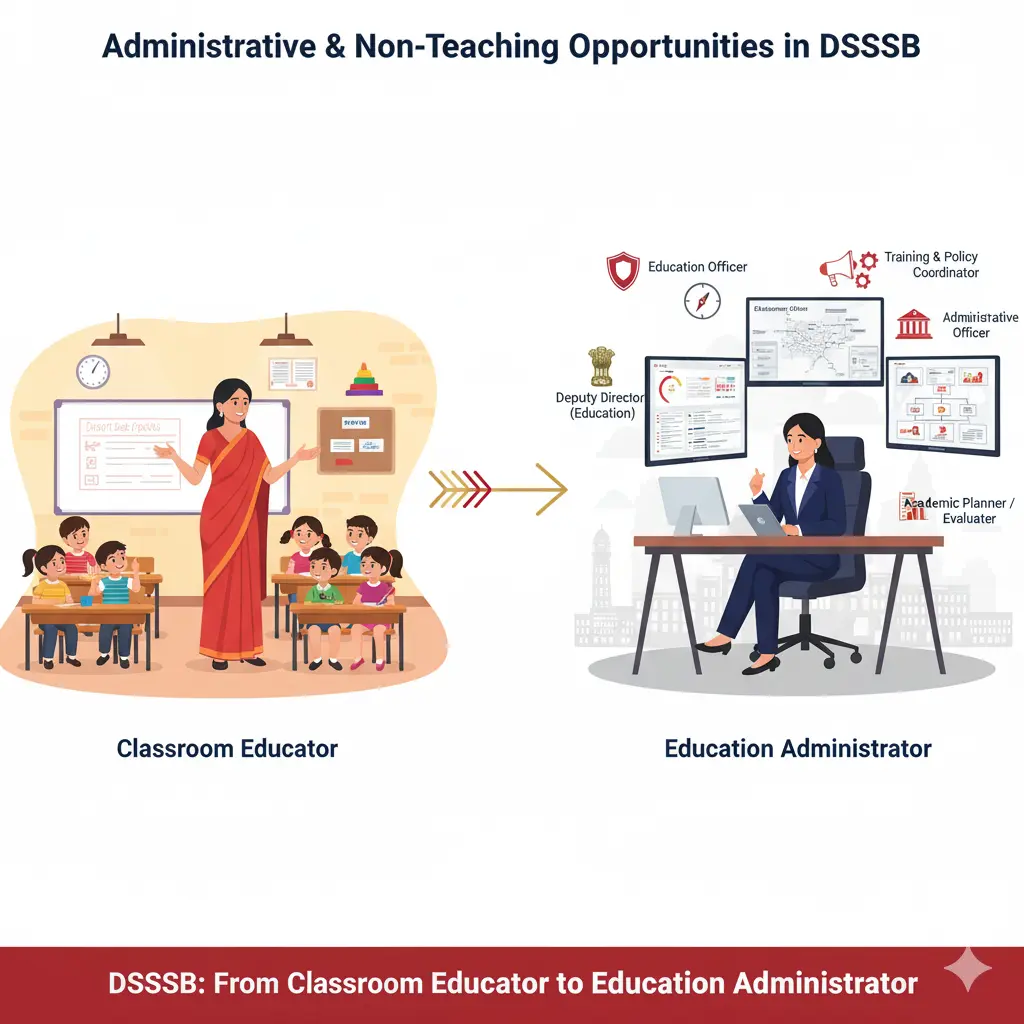
Administrative & Non-Teaching Opportunities
With time and experience, DSSSB teachers can transition into administrative and policy-level roles, contributing beyond classroom teaching.
Key Administrative Roles:
- Vice Principal / Principal: Lead the school, manage staff, ensure discipline, and maintain academic quality.
- Education Officer / Zonal Officer: Oversee multiple schools within a district or zone, supervise teachers, and conduct performance audits.
- Deputy Director / Additional Director (Education): Handle education policy, planning, and coordination across Delhi schools.
Senior officers may also work on special assignments with SCERT, NCERT, CBSE, or the Ministry of Education, gaining national exposure and influence in shaping education reform.
Such positions combine educational leadership with administrative responsibility, making them ideal for experienced and visionary educators.
Transfer, Posting & Work Environment
Unlike central government jobs, DSSSB teachers are posted within Delhi, ensuring urban postings with modern amenities.
- Transfers happen between zones, districts, or school types (DoE ↔ MCD), based on administrative needs.
- Teachers enjoy a balanced workload, smart classrooms, and access to digital infrastructure.
- Being in the capital city provides exposure to policy-level events, seminars, and training programs, further enriching professional experience.
This city-based service pattern makes DSSSB especially attractive for teachers who prefer to build a stable career without nationwide transfers.
Professional Development & Training Opportunities
The Delhi government invests heavily in teacher training through:
- SCERT (State Council of Educational Research and Training, Delhi)
- DIETs (District Institutes of Education & Training)
- DoE Capacity-Building Workshops
Teachers attend orientation, refresher, and advanced training programs covering:
- Innovative pedagogy
- Classroom technology integration
- NEP 2020 and competency-based education
- Leadership and communication skills
Outstanding teachers are also selected for:
- Curriculum development projects
- Educational research and innovation teams
- Delegations and academic collaborations at the national level
This ensures every DSSSB teacher remains professionally updated, inspired, and growth-oriented.
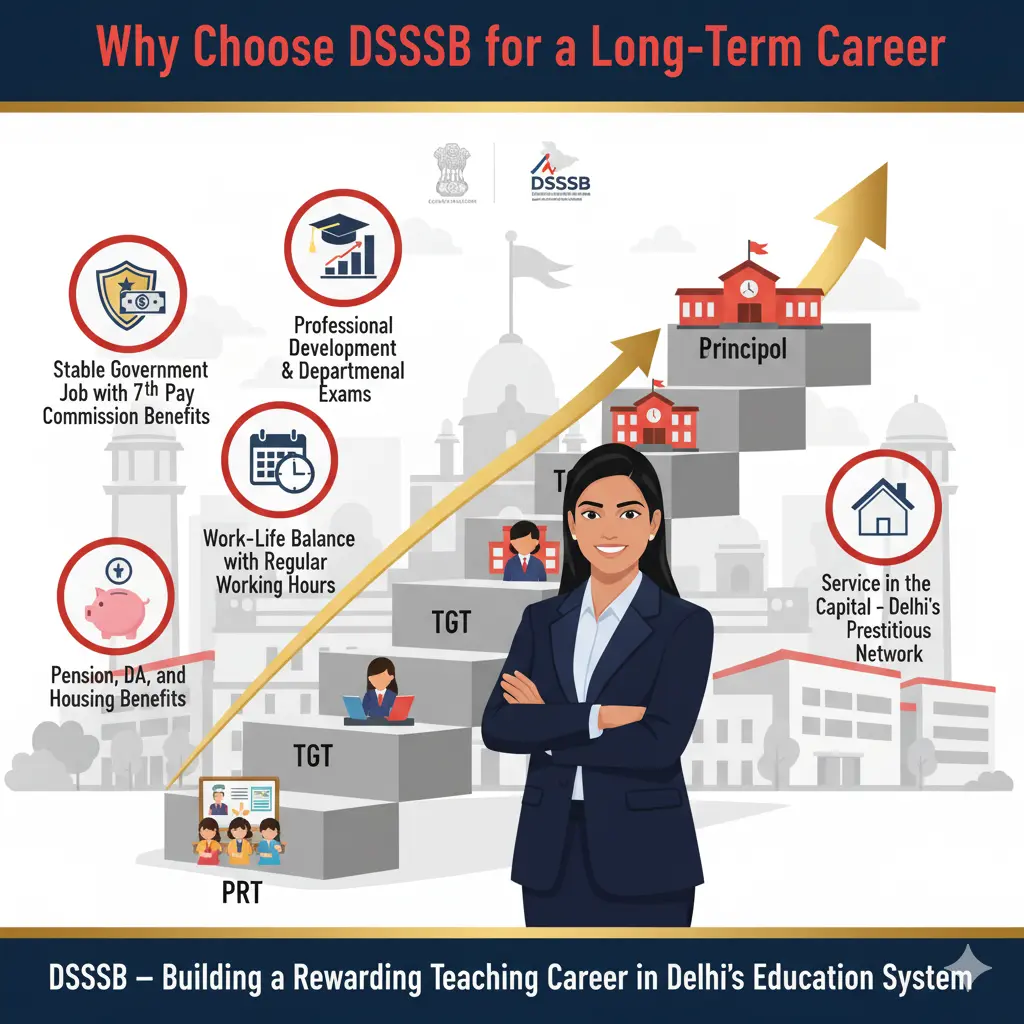
Why Choose DSSSB for a Long-Term Career
Choosing DSSSB means choosing stability, growth, and excellence in one of India’s best education systems.
Here is why it is ideal for long-term career seekers:
- 🏫 Urban Posting: All schools located within Delhi — no rural or outstation transfers.
- 💰 Strong Pay Structure: 7th CPC pay levels, high DA, and metropolitan HRA.
- 📈 Career Advancement: Promotions up to Director-level posts.
- 🎓 Continuous Training: Regular professional growth programs via SCERT & DoE.
- 👨👩👧 Work-Life Balance: Fixed hours, vacations, and family benefits (CEA, LTC, medical).
- 🇮🇳 Public Service Impact: Teachers directly shape the education quality of the nation’s capital.
Conclusion
Clearing the DSSSB Teacher Exam opens the door to one of the most respected and rewarding teaching careers in India. From a Primary Teacher shaping young learners to a principal or Education Officer leading institutions, the opportunities for growth are immense.
With steady promotions, excellent pay, urban work culture, and continuous development, DSSSB ensures that every dedicated teacher can build not just a career but a legacy in education.
If you are preparing for the DSSSB exam, remember: you are not just aiming for a job in Delhi, you are stepping into a career of lifelong learning, leadership, and contribution to India’s educational future.
FAQs on DSSSB Teacher Career Growth
1. What is the career growth path for DSSSB teachers?
DSSSB teachers progress from Primary Teacher (PRT) to TGT, then PGT, followed by Vice Principal, Principal, Education Officer, and Deputy Director of Education. Promotions are based on seniority, qualifications, and Departmental Promotion Committee (DPC) recommendations.
2. What is the salary of a DSSSB teacher after selection?
Under the 7th Pay Commission, DSSSB teachers earn:
- PRT: ₹40,000–₹75,000
- TGT: ₹50,000–₹90,000
- PGT: ₹60,000–₹1,10,000
They also receive DA, HRA, TA, Medical, and Pension (NPS) benefits.
3. How are promotions decided in DSSSB?
Promotions depend on experience, performance appraisals, seniority, and available vacancies. The Departmental Promotion Committee (DPC) conducts evaluations periodically to promote deserving candidates.
4. Can DSSSB teachers move into administrative roles?
Yes. Experienced teachers can become Vice Principals, Principals, Education Officers, Deputy Directors, and even Directors of Education. These roles involve school supervision, policymaking, and academic leadership.
5. Are DSSSB teachers transferable outside Delhi?
No, DSSSB teachers are posted within Delhi only. Transfers occur between zones or schools under the Directorate of Education (DoE) and Municipal Corporation of Delhi (MCD), not outside the city.
6. Why is DSSSB considered a good long-term career option?
DSSSB offers urban postings, strong pay, steady promotions, government benefits, and a balanced work-life. It’s ideal for educators seeking a stable, respected, and growth-driven teaching career in Delhi.


